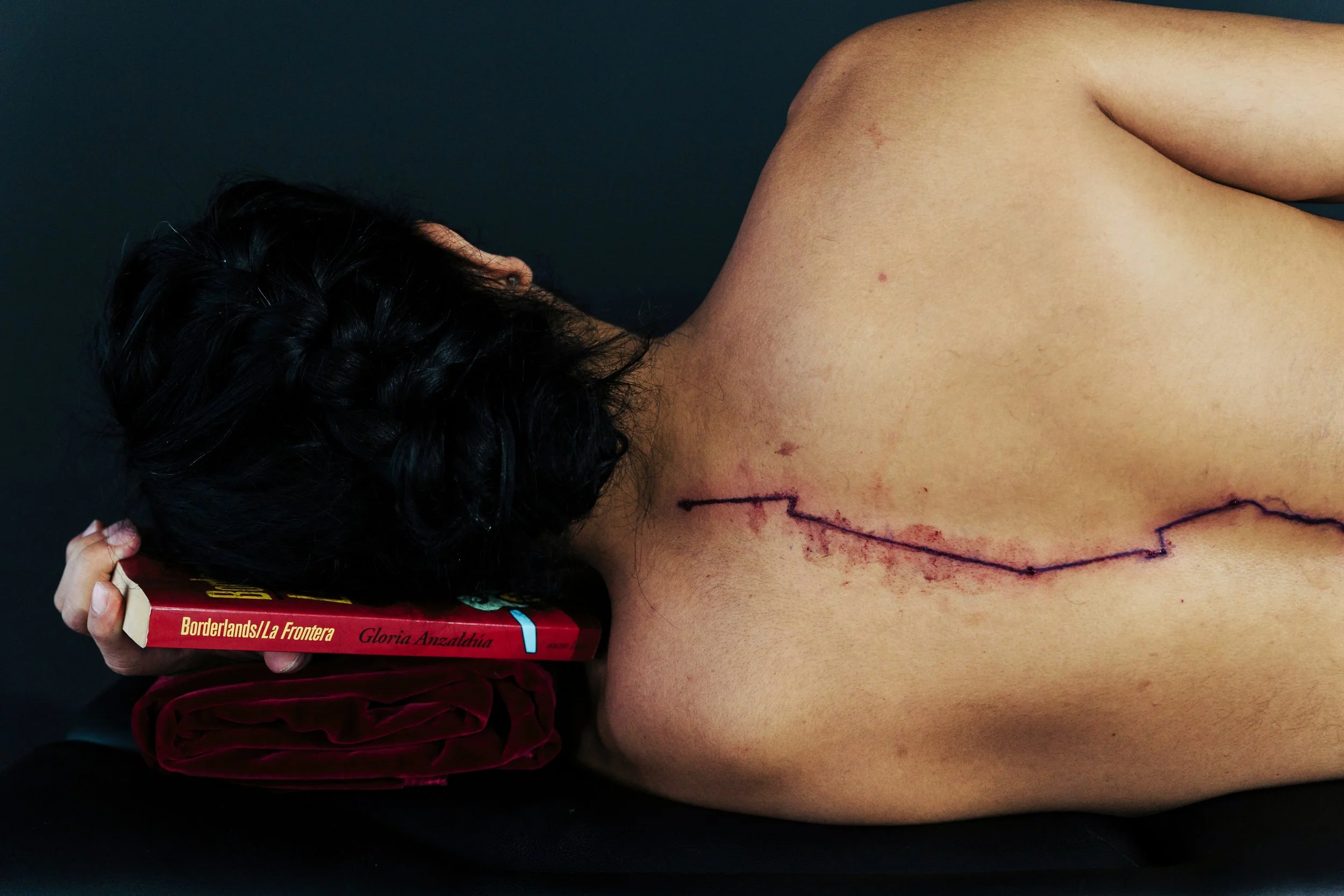
Poetry runs throughout Emilio Rojas’s practice as both a literary form and an extension of performance. Interspersed across the survey catalogue, the poems We Are Here Because You Were There, Tracing a Wound Through My Body, I–II, and Santa María, create a poetic thread connecting the artist’s recurring engagements with colonialism, migration, the body, language, memory, and historical wounds. Rather than functioning as illustrations of the artworks, the poems inhabit the same conceptual and embodied terrain, allowing language itself to become a material for tracing, rupture, repetition, and repair.
Tracing a Wound Through My Body, I–II, which was also rendered in vinyl as part of the survey exhibitions, moves between the physical processes of wounding and healing and the inherited wounds of migration, colonialism, and intergenerational trauma. Its fragmented form extends across the exhibition wall like a bodily or geographical trace.
Santa María, transforms the traditional Catholic “Hail Mary” into a decolonial incantation. The prayer’s sacred figure becomes the Santa María, the ship that carried Christopher Columbus across the Atlantic, entangling Catholic devotion with conquest, forced conversion, and genocide. Through substitution and invocation, Rojas turns the language of colonial religion back upon its history, transforming prayer into counter-memory.
We Are Here Because You Were There takes its title from the anti-colonial aphorism associated with writer and activist A. Sivanandan, whose formulation connects contemporary migration to the histories of European empire. Rojas expands this proposition into an embodied address: colonial history persists “in the marrow of our bones,” while the descendants of colonized peoples return to the imperial centers shaped by the extraction of their lands, labor, and bodies. Across the three poems, language becomes another site through which Rojas traces the wound—excavating what has been buried, inherited, or left unsaid.