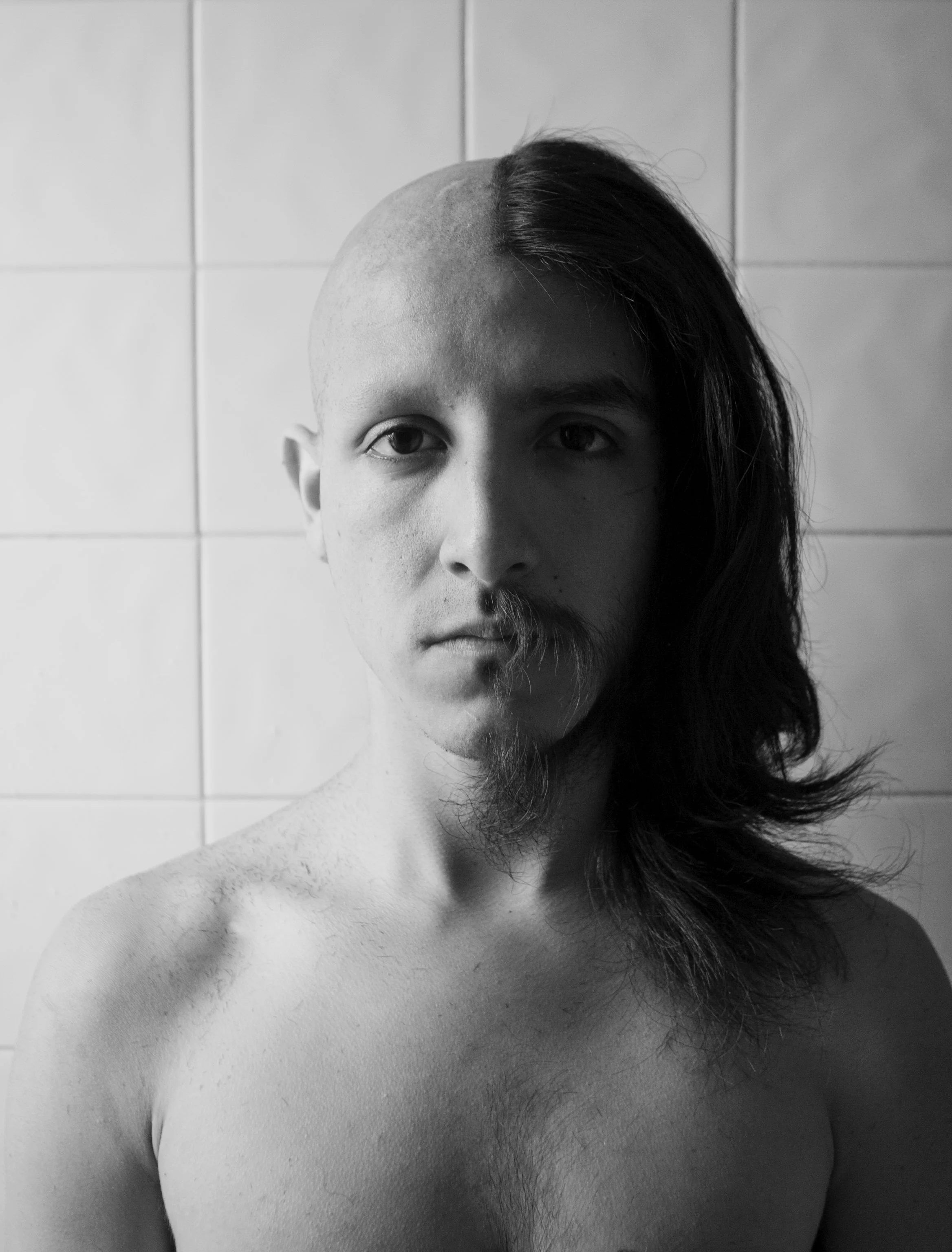
In her curatorial introduction, Exercises for Tracing, curator Laurel V. McLaughlin frames Emilio Rojas: tracing a wound through my body through the act of tracing—understood not as a search for fixed origins, but as an embodied practice of following relationships, histories, wounds, and their residues. Drawing from Gloria E. Anzaldúa’s conception of the border as una herida abierta—an open wound—McLaughlin considers how Rojas uses his body to trace the interconnected histories of colonialism, migration, queerness, borders, grief, and resistance. She organizes the survey around four recurring conceptual and material turns within Rojas’s practice:
the cut, the line, the corpus, and the scar, emphasizing their porousness and the ways individual works move between them.
McLaughlin expands upon this framework in Such That One Can Be Rendered Again, focusing on works produced between 2009 and 2013. Through performances including Colon, El Mestizo, El Grito, Caminografías, El Salto, Meta+pherein, and Nationalism & Sports; the only way to love, she examines how Rojas’s body becomes both an instrument and a site upon which colonial, national, racialized, and queer histories collide. Bringing Billy-Ray Belcourt’s notion of “rendering” into dialogue with queer theories of temporality, McLaughlin considers how endurance, repetition, trespass, bodily transformation, homoeroticism, and duration allow histories conventionally understood as past to persist—and be contested—in the present.
Read together, the two essays position tracing and rendering as interconnected methodologies within Rojas’s practice. The wound is neither simply represented nor resolved; it is repeatedly returned to, inhabited, and transformed. Through these acts of embodied return, McLaughlin argues, Rojas exposes the “rips” and “severs” produced by colonial histories while opening the body toward other forms of relation, resistance, and becoming—toward what Anzaldúa imagines as the transformation of the wound into a bridge.